 ChatGPT
 Gemini
 Claude
 Perplexity
 Copilot
 DeepSeek
 Meta
Meta01
Missing from discovery
Buyers ask a relevant question. AI mentions the market—but leaves your company out.
AI PERCEPTION INTELLIGENCE & MANAGEMENT
See how AI understands, compares, and recommends your company. Find the perception gaps. Build a clear plan to improve them.
Understand your presence across the AI systems buyers use
THE PERCEPTION GAP
Your website tells one story. AI may tell another. Understand where your company is overlooked, misrepresented, or passed over for a competitor.
Buyers ask a relevant question. AI mentions the market—but leaves your company out.
You position an enterprise platform. AI describes a consulting agency.
AI knows your brand, but recommends a competitor when the buyer gets specific.
PERCEPTCORE PULSE
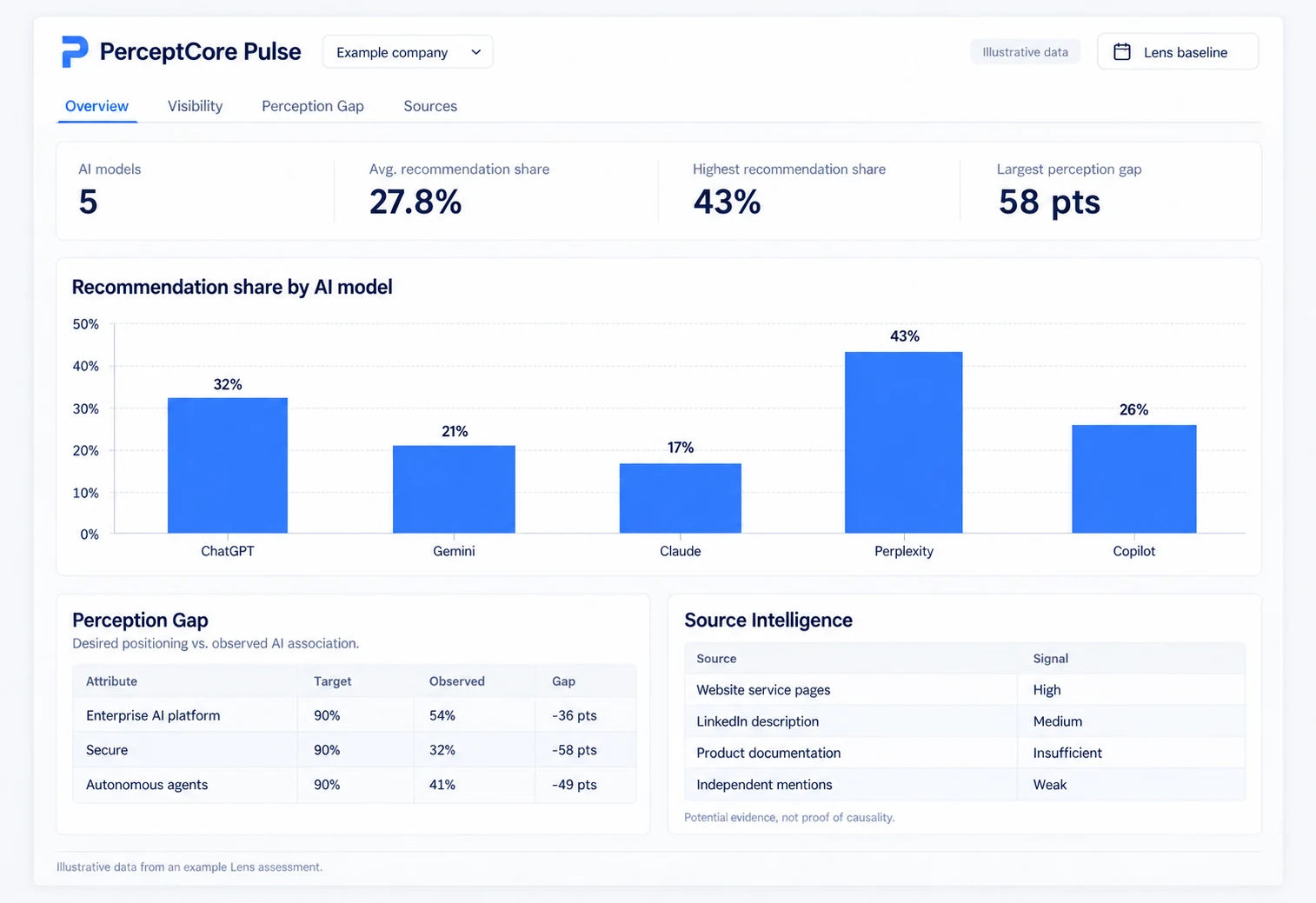
Track how AI perception changes. PerceptCore Pulse connects visibility, positioning, and source intelligence.
Measure how often AI recommends a company across the questions buyers actually ask.
Recognition does not always lead to recommendation. Compare models to understand where your company enters the conversation—and where it disappears.
Compare the positioning you want with the associations AI actually makes.
| Attribute | Target | Observed | Gap |
|---|---|---|---|
| Enterprise AI platform | 90% | 54% | -36 pts |
| Secure | 90% | 32% | -58 pts |
| Australia-focused | 80% | 58% | -22 pts |
| Autonomous agents | 90% | 41% | -49 pts |
| Deep workflow integrations | 85% | 37% | -48 pts |
| Enterprise support automation | 90% | 66% | -24 pts |
Security has the largest gap in this example: 90% desired, 32% observed. That gives a Lens assessment a concrete question to investigate.
Identify potential sources shaping the way AI describes a business.
| Information source | Evidence signal |
|---|---|
| Website service pages | High influence |
| LinkedIn company description | Medium influence |
| External directories | Medium influence |
| Product documentation | Insufficient |
| Independent product mentions | Weak |
| Customer reviews | Insufficient |
| Structured product entities | Weak |
In this example, evidence describing a service provider outweighs evidence describing a software platform. Source analysis helps explain the positioning gap.
Potential evidence, not proof of model causality.
Illustrative data from a Lens assessment, not measured customer results.
Understand when your company is mentioned and when it is recommended.
Compare your desired identity with the categories and attributes AI associates with you.
Investigate influential information and spot incorrect or outdated claims.
See how AI understands your company relative to the alternatives buyers consider.
FROM UNDERSTANDING TO ACTION
A baseline tells you where you stand. An ongoing perception strategy helps you decide what to change—and whether it worked.
YOUR STARTING POINT
See your business through the eyes of AI. Establish your perception baseline and identify the gaps.
A clear baseline. A prioritized action plan.
See how the process worksYOUR CONTINUOUS LOOP
Turn perception gaps into targeted action with ongoing improvements, re-testing, and reporting.
A coordinated strategy. Measured progress.
See how the process worksLens reveals the gaps. Pulse tracks the changes. Shift helps you act.
HOW IT WORKS
Each intervention starts with evidence and ends with another measurement.
Test buyer questions across AI systems and establish your visibility and perception baseline.
Identify gaps, inaccurate claims, competitive differences, and potential source influences.
Improve the content, documentation, positioning, and evidence supporting your business.
Re-test to see what changed, track progress, and refine the next set of actions.
BUILT AROUND CONSIDERED PURCHASES
Especially relevant when buyers use AI to explore a category, compare vendors, and evaluate a substantial purchase.
SaaS, cybersecurity, AI platforms, cloud infrastructure, and enterprise software.
Consulting, technology services, and specialist businesses competing on expertise and trust.
Marketing, brand, strategy, and product teams that need a shared view of AI perception.
A FEW USEFUL ANSWERS
Lens examines brand perception, visibility across relevant AI systems, competitor positioning, buyer questions, factual accuracy, and potential source influences. It compares the identity you want with the understanding AI demonstrates, then turns those gaps into a prioritized roadmap.
Visibility asks whether AI mentions your company. Perception asks what AI thinks your company is: its category, capabilities, markets, strengths, and differences. Recommendation intelligence goes further by examining whether AI considers your company a good fit for a buyer’s requirements.
Relevant systems can include ChatGPT, Gemini, Claude, Perplexity, Copilot, and AI search experiences. The right set depends on your buyers, markets, and use cases. A Lens assessment defines that scope around your business rather than treating every model as equally important.
AI systems draw on different combinations of training knowledge, search retrieval, web indexes, and other information. Publishing content does not guarantee a change in model behavior. PerceptCore focuses on improving the quality, consistency, and authority of supporting information, then measuring the observed changes.
Establish a baseline, make targeted improvements, and re-test the relevant buyer questions. Compare visibility, positioning, accuracy, and recommendation behavior over time. Source evidence helps investigate what may have contributed; an observed change alone does not prove causality.
Lens establishes your AI perception baseline and action plan. Pulse tracks visibility, perception, recommendations, and source intelligence. Shift brings an ongoing team and strategy to targeted improvements, reporting, and continuous validation.
START WITH A CLEARER PICTURE
Make the perception gap visible. Then build a plan to improve it.